The current public debate on the proposed amendments to the Law on Identity Card, [1] which provide for the inclusion of ethnicity of citizens in ID cards, has opened important issues of social, constitutional and integration character. Namely, as seen in Article 1 of the existing law, the ID card is a public document that proves the identity, citizenship and address of the citizen. Hence, the introduction of the column for ethnicity redefines the meaning of the ID card by undermining the civic identity at the expense of the ethnic one and challenging the integration of the country into the European Union because no member state of the Union has established such a practice.
- Draft-amendments to the Law on Identity Card
The initiative to amend the Law on Identity Card dates back to September 2020, [2] when the Ministry of Interior proposed several amendments to the Parliament to harmonize this law with the Law on Misdemeanors. [3] However, at the end of January and the beginning of February 2021, in the Parliament of the Republic of North Macedonia, several political parties submitted amendments to the draft law amending the Law on Identity Card. In the public, the main focus was given to the amendments in the direction of the proposal for inserting a column in the ID cards for the ethnicity of the citizens. Given that the reactions to these proposals range from complete opposition, to the acceptance of mandatory or optional inclusion of ethnicity in ID cards, it is worth considering national and international legislation in order to give a legal review and opinion on the proposal.
- Constitution of the Republic of North Macedonia
According to Article 8 paragraph 1 line 2 of the Constitution, part of the fundamental values of the constitutional order are: free expression of nationality and adequate and equitable representation of citizens belonging to all communities in state bodies and other public institutions at all levels. [ 4]
It is in the center of Article 8 paragraph 1 line 2 of the Constitution that the motives of the proposal for entering the ethnicity of the citizens in their ID cards should probably be sought. [5] The proposer probably had in mind the advertisements for employment in the public administration, [6] for which according to the Law on Civil Servants, [7] and the Law on Public Employees, [8] one of the conditions of the advertisement is stating the ethnicity of the candidate, which is given by the so-called balancer for the specific job. So far, dozens of lawsuits have been filed in the courts, in which the rejected candidates as plaintiffs, among other things, sought to establish the illegality of the employment procedure. However, the case law is unanimous. Free expression of ethnicity is an expression of personal conviction and is a constitutionally guaranteed right.
At the same time, the equitable representation of all communities in state bodies is a constitutionally guaranteed right. But here the question arises, whether the introduction of ethnicity in the ID cards helps or hinders this process. In particular, the question arises whether the inclusion of ethnicity in ID cards, in the light of the fundamental constitutional value – equitable representation, actually vulgarizes this constitutional value, because it seeks to turn it into a rigid mathematical representation, whereby the mandatory declaration of ethnicity in The entry of data in the ID card will mean a kind of sealed written statement on ethnicity, which will further prevent the courts from interpreting the free expression of nationality in the liberal-democratic spirit of the constitution.
In fact, there is no obstacle that currently prevents institutions from ensuring equitable representation and preventing abuses, [9] and there is no guarantee that the proposed changes will improve interethnic cohesion.
Finally, having in mind the percentage of the smaller ethnic communities in the total population of the Republic of Northern Macedonia, it is clear that the so-called balancer rarely provides information that a certain job provides employment of a member of the smaller ethnic communities (Turks, Vlachs, Roma, Bosniaks, Serbs, etc.). Having in mind the socio-economic situation in the country, and hence the acceptability of employment in the state administration bodies, the question arises whether the mandatory entry of ethnicity in ID cards will actually mean an open door for self-assimilation of smaller ethnic communities and their gradual merging into two domains. ethnic communities.
Additionally, in the area of equitable representation of communities, there is an impression that smaller ethnic communities are only observers of the process, given that interethnic relations in the public discourse are predominantly presented as relations between the two largest ethnic communities. In particular, although the Decade of Roma is declared declaratively, still for this marginalized ethnic community, the positive discrimination can in no way be met by stating their ethnicity in the ID cards. On the contrary, almost every year, examples of police brutality and discrimination against Roma are noted, precisely because of their ethnicity. Therefore, the negative reaction of the Roma associations is understandable, as they have already expressed concern about the consequences that may arise from this draft law.
Comparative data and experiences
From the data recorded in the already issued ID cards, it is clear that the existing Law on Identity Card operates with the term “citizenship”, which comparatively, [10] makes the Republic of Northern Macedonia one of the 49 countries with such access to the data listed in the ID card.
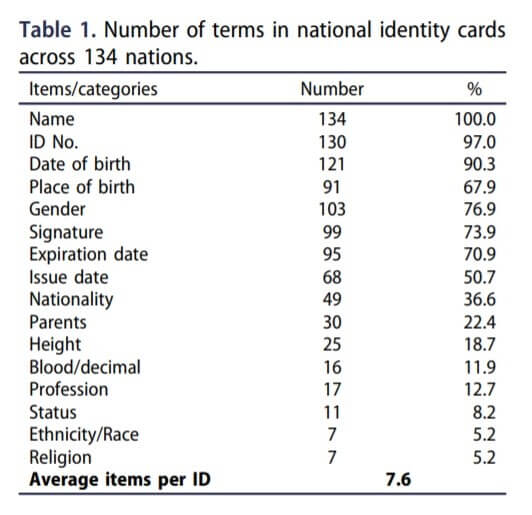
Data available in identification documents in 134 countries
Although the data “citizenship / nationality” in the world participates with 36.6%, still at the level of Europe, this approach is in the majority, ie participates with 53.1%, and, comparatively compared to other continents, it is noticeable that the countries of the European continent predominate in this approach.
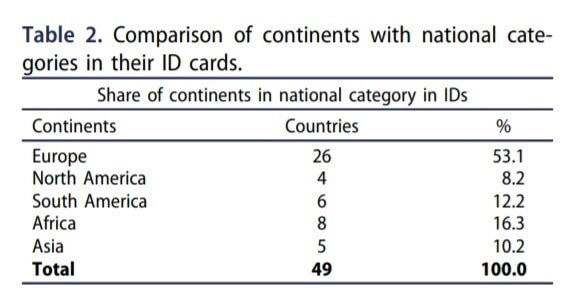
Comparison between continents by citizenship category in their ID cards
As for the topic of this legal review and opinion regarding the inclusion of a column on ethnicity in the ID cards, the comparative data are absolutely unfavorable for the proposed changes, because no country in Europe, and hence no member state of The EU does not provide for the inclusion of citizens’ ethnicity in their ID cards.
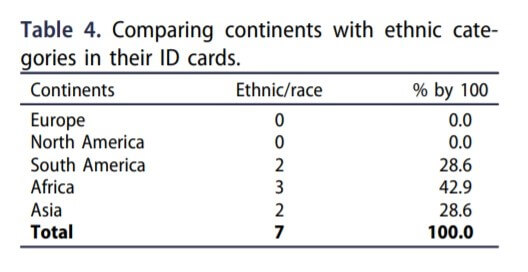
Comparison between continents by ethnic categories in ID cards
- Conclusion
Comparing the data in the ID cards of the citizens-citizens of 134 countries in the world, the comparative experiences indicate the negative implications of entering ethnic or religious affiliation in the ID cards. Due to this, many countries in recent years have either completely abandoned this approach, or made the entry of ethnicity in the ID cards optional, ie left it to the citizens to decide whether the ethnicity will be entered in their ID card. However, having in mind the strategic determination of the Republic of North Macedonia for full membership in the European Union, it is again necessary to note the fact that no member state provided for the inclusion of ethnicity in the ID cards of their citizens.
Finally, in order to consistently respect and fulfill the fundamental constitutional value of adequate and equitable representation of citizens in state bodies and other public institutions at all levels, Macedonian society has at its disposal a number of ways to improve the situation that should start with education. , economy and social policy, without touching on the constitutional fundamental value of the free expression of national, i.e. ethnicity.
………………………………………………………………………………………………………………………………………………………………
[1] Law on the ID Card (“Official Gazette of the Republic of Macedonia” No. 8/1995, 38/2002, 16/2004, 12/2005, 19/2007, 10/2010, 51/2011, 13/2012, 166 / 2012, 154/2015 and 55/2016).
[2] Although primarily the purpose of the proposed amendments was completely different because the Ministry of Interior announced that the proposed amendments to the law will enable harmonization of the misdemeanor provisions of the Law on ID card with the provisions of the new Law on Misdemeanors, in order to determine new amounts of fines for offenses committed by natural, official, authorized and legal entities.
[3] Law on Misdemeanors (“Official Gazette of the Republic of Macedonia” No. 96/2019).
[4] Note: Nowhere in the constitutional text, i.e. in any of its provisions, is the term “ethnicity” mentioned, hence, evident from Article 110 which prescribes the prohibition of discrimination of citizens on the grounds of sex, race, religion, national, social and political affiliation, it is clear that in the Constitution, national affiliation has the meaning of ethnicity.
[5] Deutsche Welle in Macedonian, Katerina Blazevska “Will ethnicity be included in ID cards?”, Available at: https://p.dw.com/p/3p9A1
[6] Deutsche Welle in Macedonian, DTZ “Ethnicity is closer to entering ID cards”, available at: https://p.dw.com/p/3pZPz
[7] Law on Administrative Servants (“Official Gazette of the Republic of Macedonia” No. 27/14, 199/14, 48/15, 154/15, 5/16, 142/16 and 11/18 and “Official Gazette of the Republic of North Macedonia” No. 275/19 and 14/20).
[8] Law on Public Sector Employees (“Official Gazette of the Republic of Macedonia” No. 27/14, 199/14, 27/16, 35/18 and 198/18 and “Official Gazette of the Republic of Northern Macedonia” No. 143 / 19 and 14/20).
[9] In the past 10 years, the Ombudsman in the special reports on an annual basis, notes progress in the implementation of the principle of adequate and equitable representation, but also insufficient capacity of certain institutions to implement this principle. Hence, the insufficient progress in implementing the principle of adequate and equitable representation is an exception, not a rule, due to which we believe that the inclusion of ethnicity in the ID cards of all citizens will not in itself correct the noted weaknesses due to insufficient capacity of institutions. Available at: http://ombudsman.mk/MK/posebni_izveshtai.aspx
[10] The spreadsheet data is retrieved from https://fpjra.org/wp-content/uploads/2020/06/3.-ID-cards-Conflicts.pdf.